On almost every Toubkal trek, the real heroes walk on four legs. Mules and their muleteers carry bags, food and gear from Imlil to the refuge and between villages, letting you climb with a light daypack. This guide explains how Toubkal mules and porters work, what they can carry, how much to budget, tipping etiquette and how to make sure the animals are treated well.
How do mules and porters work on Toubkal?
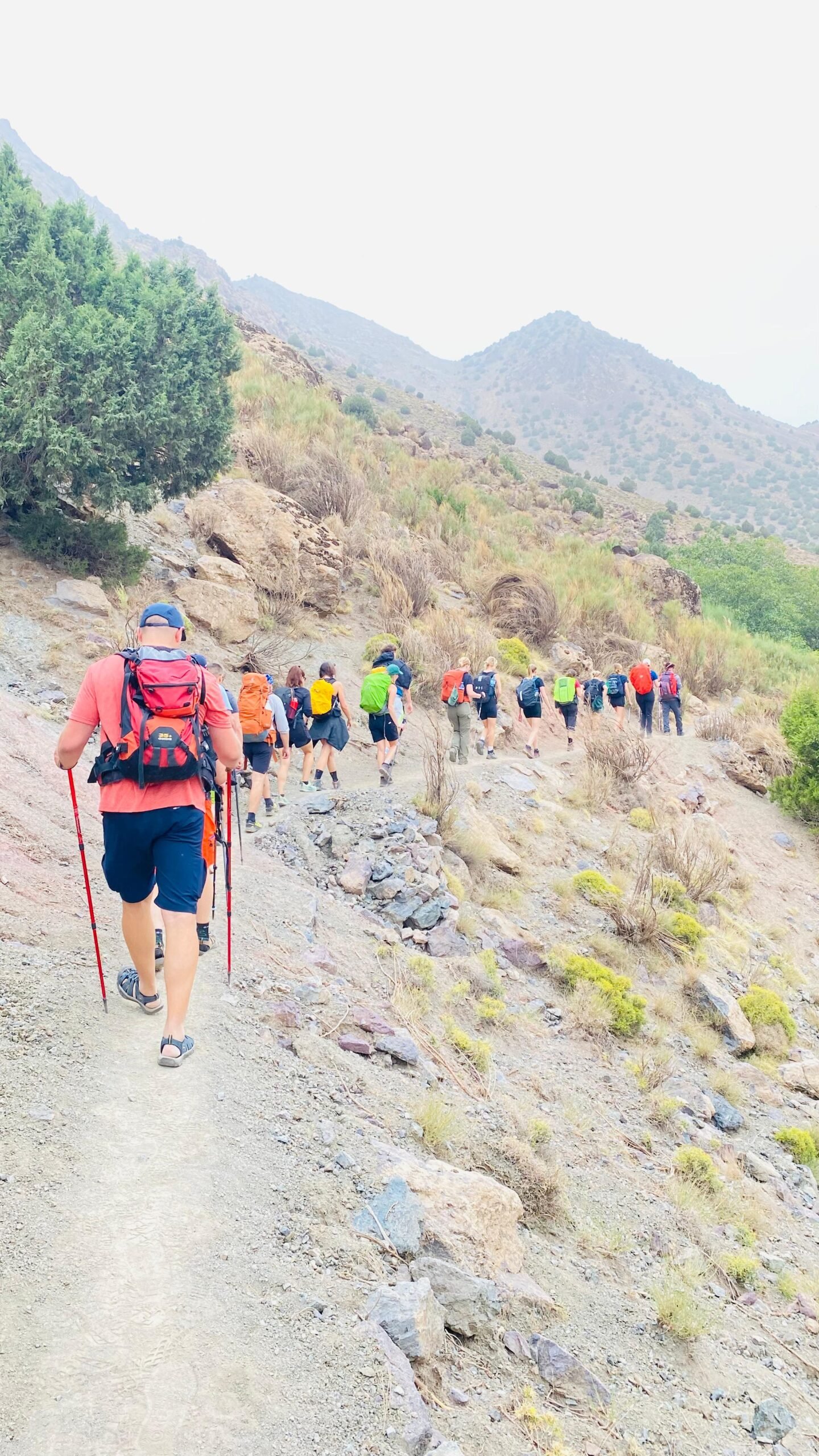
On Toubkal, luggage is carried mainly by mules (and sometimes donkeys) led by a local muleteer, rather than by human porters. On the classic route, mules go from Imlil (about 1,740 m) up the Mizane valley to the Toubkal refuge (about 3,200 m). They do not go higher: on summit day you carry your own daypack. On multi-day treks, mules also move camping gear, food and the cook's kitchen between camps.
Mules are usually included in our multi-day programmes such as the 5-day Berber villages and Toubkal summit trek and the 6-day Toubkal circle trek. On the 2-day Toubkal trek, ask whether a mule for luggage is included or available as an option.
Who is in a typical Toubkal trekking team?
| Team member | Role | Usually on |
|---|---|---|
| Licensed guide | Leads, sets pace, responsible for safety | All treks (required for Toubkal) |
| Muleteer | Loads, leads and cares for the mule(s) | Most 2–7 day treks |
| Mule or donkey | Carries bags, food, tents and kitchen | Most multi-day treks |
| Cook | Prepares meals at camps | Camping treks, larger groups |
| Human porter | Carries loads where mules cannot go | Rare; some winter or special routes |
How much can a mule carry?
A mule can carry a substantial load, but responsible teams keep it reasonable for the animal's health, especially on steep paths. Agencies usually set a weight limit per trekker for the main bag; around 10–15 kg is a common guideline, but ask your agency for its exact rule. Practical tips:
- Use a soft duffel bag rather than a hard suitcase: it is easier and safer to tie on a mule.
- Put fragile items and electronics in your daypack, not in the mule bag.
- Line your duffel with a plastic or dry bag: mule bags get dusty and may get wet at river crossings.
- Keep everything you need during the day (water, layers, snacks, sunscreen) in your daypack, because the mule often walks at a different pace.
Do mules go to the Toubkal summit?
No. Mules stop at the refuge area. The terrain above, steep scree and in winter snow and ice, is unsuitable for animals. On summit day you carry a 20–30 litre daypack with warm layers, water and snacks. Our summit day guide lists exactly what to take.
Can you hire a mule to ride up to the refuge?
Riding mules is sometimes possible on the easier lower sections of the valley, for example if a trekker is tired or has a minor injury, but it is not a substitute for walking the route. The path to the refuge has steep, narrow and rocky stretches where riding is uncomfortable and can be unsafe. Discuss it with your guide in advance; never insist if the muleteer says no.
Mule welfare: what responsible trekkers look for
Most muleteers depend on their animals for their livelihood and take good care of them. As a trekker, you can encourage good practice:
- Respect the weight limit and pack light.
- Look at the equipment: well-padded saddles and properly tied loads prevent wounds.
- Notice the rhythm: animals should have water, food and rest at stops.
- Speak to your guide calmly if you see something worrying; a reputable agency will take it seriously.
- Learn more: the charity SPANA works with working animals and their owners in Morocco and publishes advice for travellers.
A day with the mule team
On a typical trek day, the muleteer is up before the trekkers, feeding and watering the animals. After breakfast, bags are brought out, weighed by eye and tied in balanced pairs on each side of the saddle, with tents or the kitchen box on top. The mule usually leaves a little after the group and often overtakes it on the climb, arriving at the next gîte, camp or refuge first. By the time you arrive, your bag is waiting. In the evening the muleteer settles the animals in a stable or a sheltered spot near the camp, and many muleteers join the guide for tea and conversation around dinner.
How much should you budget for mules?
On packaged treks, mules and muleteers are usually included in the price, which is the simplest option. If you book a guide only, a mule is generally charged per day and covers the animal and muleteer. Prices vary with season, number of mules and route, so ask for a written quote that lists the mule, muleteer, food and any extra fees. Remember that the muleteer often needs to walk back the same day or the next day, which is part of the cost.
Tipping guides, muleteers and cooks
Tipping is customary in Moroccan mountain tourism and is an important part of the team's income. Common practice is to tip at the end of the trek, separately for the guide, the muleteer and the cook, in cash dirhams. Amounts depend on trek length and group size; ask your agency for a typical range before you travel so you can withdraw enough cash in Marrakech, as ATMs in Imlil are limited.
| Tip to | When | Tip |
|---|---|---|
| Guide | Last day, in person | Usually the largest share |
| Muleteer | Last day, in person | Per muleteer, not per mule |
| Cook | Last evening or last day | On camping treks |
Why mules make Toubkal more enjoyable
Walking with a light daypack changes everything on a high-altitude trek. You breathe more easily on the climb to the refuge, your knees suffer less on the descent and you have energy left to enjoy the villages, the shrine of Sidi Chamharouch and the views of the High Atlas. Mule teams are also a major source of income in the Imlil valley, so using them supports the local economy directly. For families, mules are often the highlight of the trip, as we explain in our guide to Toubkal with kids.
Key takeaways
- On Toubkal, mules and muleteers carry luggage from Imlil to the refuge; human porters are rare.
- Mules do not go above the refuge; you carry a daypack on summit day.
- Pack a soft duffel within your agency's weight limit (often around 10–15 kg).
- Tip guide, muleteer and cook separately in dirhams at the end of the trek.
Want a trek with full mule support? Explore our 6-day Toubkal trek or ask our team to add a mule to a shorter itinerary.